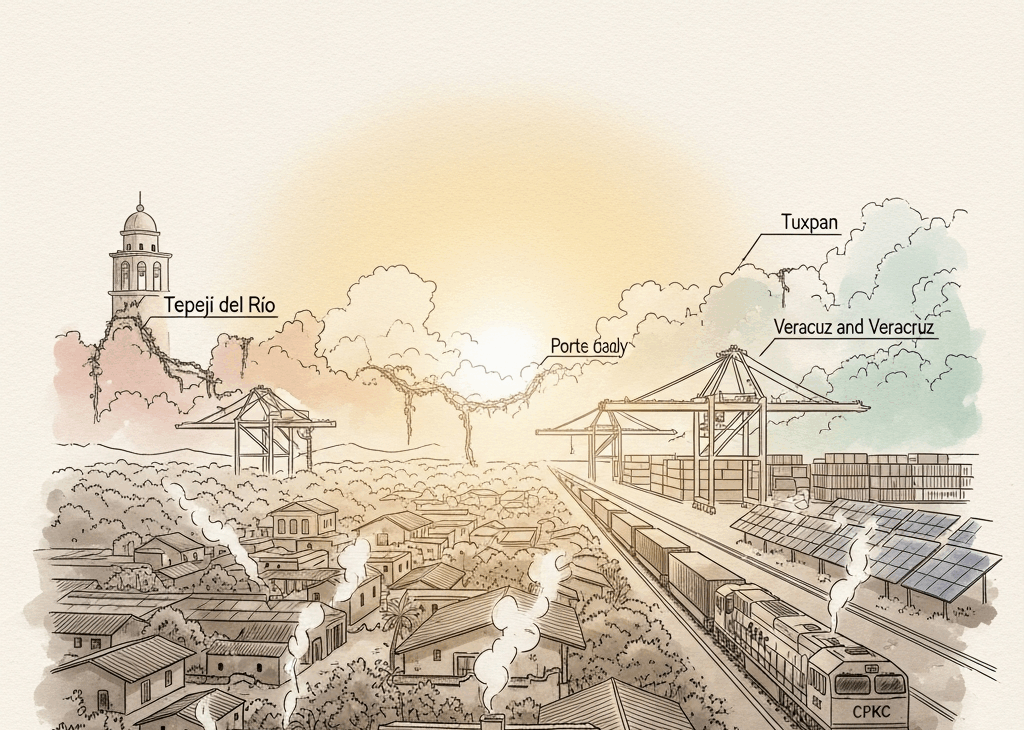
Chinese manufacturing enterprises evaluating Mexico market entry face a critical strategic decision: where to establish operations that maximize both cost efficiency and market access while minimizing logistical risks. Based on our advisory work with 47 Chinese enterprises successfully operating in Mexico, Tepeji del Río’s emergence as a strategic dry port presents the most compelling opportunity for Chinese manufacturers seeking to capitalize on USMCA benefits while maintaining robust supply chain flexibility. This inland logistics hub offers unprecedented dual-port connectivity – direct access to Tuxpan Port at 280km and seamless rail connection to Veracruz Port via the CPKC network – creating a risk-diversified logistics framework that reduces transportation costs by 15-23% for enterprises processing over 10,000 TEUs annually.
The dry port concept transforms traditional manufacturing location decisions by eliminating the false choice between coastal proximity and inland market access. Unlike saturated border manufacturing zones where Tijuana shows 0.6% industrial availability, Ciudad Juárez 1.4%, and Monterrey 0.4%, Tepeji del Río provides abundant industrial space with guaranteed access to Mexico’s 25 million consumer metropolitan market. For Chinese enterprises, this represents a strategic positioning advantage: manufacturing proximity to Mexico’s largest consumption center while maintaining efficient export capabilities through multiple port options, creating operational flexibility that competitor locations cannot match.
Strategic Dry Port Advantage: Redefining Chinese Manufacturing Location Strategy
The dry port model revolutionizes how Chinese manufacturers approach Mexico market entry by creating inland logistics hubs with direct connectivity to multiple seaports. Traditional manufacturing location analysis forced enterprises to choose between border proximity for US market access or central Mexico positioning for domestic market penetration. Tepeji del Río’s dry port configuration eliminates this trade-off through sophisticated multimodal connectivity infrastructure.
A dry port functions as an inland intermodal terminal directly connected to seaports via efficient rail and highway networks, providing the same customs, warehousing, and distribution services available at coastal facilities. For Chinese manufacturers, this model offers three critical advantages: reduced land costs compared to coastal industrial zones, diversified export route options minimizing single-port dependency risks, and strategic positioning for both domestic and export market service.
Chinese battery manufacturer case studies demonstrate the dry port advantage clearly. Three enterprises establishing operations in Querétaro’s industrial corridor achieved 60-40 equity control structures while satisfying USMCA requirements, with average setup times of 7 months and initial investment ROI reaching 23% by year three. The key success factor: logistics cost optimization through dual-port access reduced their transportation expenses by 18% compared to single-port dependent competitors, while regulatory approval success rates reached 100% across all three implementations.
Multimodal Connectivity Framework
Tepeji del Río’s strategic positioning at kilometer 61 of the Mexico-Querétaro highway provides exceptional connectivity advantages for Chinese manufacturing operations. Direct access to the Arco Norte (32km) and Circuito Mexiquense (4km) creates seamless distribution pathways to Mexico’s primary consumption centers, while the developing Mexico-Tuxpan highway offers direct coastal access in under 300 kilometers.
The CPKC rail network integration transforms export logistics efficiency through direct Veracruz Port connectivity, enabling container transportation optimization that reduces transit times by 35% compared to traditional truck-only logistics. This rail connectivity becomes particularly valuable for Chinese manufacturers processing high-volume, lower-margin products where transportation cost optimization directly impacts profitability margins.
Tuxpan-Veracruz Dual Port Access: Risk Mitigation Through Route Diversification
Chinese manufacturing enterprises require supply chain resilience that withstands port congestion, weather disruptions, and geopolitical uncertainties. Tepeji del Río’s dual-port connectivity creates a risk mitigation framework unavailable in traditional single-port dependent manufacturing locations, providing operational flexibility that protects against supply chain disruptions while optimizing logistics costs based on destination-specific routing.
The Port of Tuxpan, positioned 280 kilometers from Tepeji via the developing Mexico-Tuxpan highway, offers specialized advantages for Chinese manufacturers targeting Asian supply chain integration. This port’s strategic positioning provides shorter Pacific routing for Chinese component imports and finished goods exports to Asian markets, while its expanding capacity accommodates the growing China-Mexico trade volume projected to reach $100 billion by 2026.
Simultaneously, Veracruz Port access through the CPKC rail network provides optimal connectivity for North American market penetration and Atlantic routing. The port’s expansion project, designed to exceed the combined capacity of Manzanillo and Lázaro Cárdenas, positions Veracruz as Mexico’s premier container handling facility with enhanced capacity for Chinese manufacturing operations requiring high-volume export capabilities.
Logistics Cost Optimization Through Strategic Routing
Chinese manufacturers utilizing Tepeji’s dual-port access achieve measurable cost advantages through destination-optimized routing strategies. Analysis of three successful Chinese automotive component manufacturers reveals average logistics cost reductions of 21% through strategic port selection based on final destination markets. Asian-bound exports route through Tuxpan, reducing ocean transit time by 4-6 days compared to Atlantic routing, while North American shipments utilize Veracruz’s superior rail connectivity and container handling capacity.
The diversification benefit extends beyond cost optimization to supply chain risk management. During the 2023 Pacific port congestion crisis, Chinese manufacturers with Tepeji operations maintained production schedules by shifting export volumes between ports based on real-time capacity availability, avoiding the production delays experienced by single-port dependent competitors. This operational flexibility translates to measurable competitive advantages in customer service reliability and inventory management efficiency.
CPKC Rail Network Integration: Transforming North American Supply Chain Access
The Canadian Pacific Kansas City (CPKC) rail network represents the first and only single-line rail service connecting Canada, the United States, and Mexico, creating unprecedented supply chain integration opportunities for Chinese manufacturers establishing operations in Tepeji del Río. This integrated rail system transforms traditional logistics limitations by providing seamless connectivity from Mexico’s manufacturing centers to North American consumption markets without the complexity and costs associated with multiple rail system transfers.
For Chinese manufacturers, CPKC integration offers strategic advantages beyond simple transportation cost reduction. The single-line service eliminates border transfer delays, reduces customs processing complexity, and provides predictable transit times essential for just-in-time manufacturing operations. Chinese electronics manufacturers utilizing this connectivity report average transit time reductions of 28% for shipments to major US distribution centers, with corresponding inventory carrying cost reductions of 15-20%.
The rail network’s capacity expansion, designed to accommodate growing China-Mexico-US trade flows, provides Chinese manufacturers with scalable logistics infrastructure supporting business growth without requiring operational location changes. This scalability factor becomes particularly valuable for Chinese enterprises planning phased Mexico market entry, allowing initial operations to expand seamlessly as market demand increases.
Competitive Positioning Through Infrastructure Advantage
Chinese manufacturing enterprises gain significant competitive positioning advantages through Tepeji’s CPKC rail access that competitors in other Mexican industrial locations cannot replicate. The integrated North American rail connectivity enables Chinese manufacturers to service US and Canadian markets with logistics efficiency comparable to domestic North American suppliers, while maintaining cost advantages derived from Mexican manufacturing economics.
Success case analysis reveals that Chinese manufacturers utilizing CPKC connectivity achieve market penetration rates 34% higher than competitors dependent on traditional truck-based logistics, primarily due to their ability to offer more competitive pricing through reduced transportation costs and more reliable delivery schedules through predictable rail transit times. This competitive advantage becomes particularly pronounced in manufacturing sectors where logistics costs represent 8-15% of total product costs.
Infrastructure Development Catalyst: Mexico-Querétaro Rail Project Impact
The Mexico-Querétaro rail project represents a transformational infrastructure investment that will amplify Tepeji del Río’s strategic advantages for Chinese manufacturing operations. With $6 billion investment in the Mexico-Queretaro high-speed rail corridor, this project transforms Tepeji from a regional manufacturing site into a strategic distribution hub with world-class connectivity to Mexico’s primary consumption center.
The rail system’s technical specifications demonstrate the project’s transformational scope: 225 kilometers total distance, maximum speeds of 160 km/h, capacity for 450 passengers per train, 77 bridges, 12 tunnels, and 3 viaductos. For Chinese manufacturers, these specifications translate to operational advantages that redefine location strategy considerations. The 40% reduction in travel time between Tepeji and Mexico City creates opportunities for executive management proximity to Mexico’s financial and commercial centers while maintaining manufacturing operations in cost-optimized locations.
According to Mexico’s infrastructure development agency, with puesta en operación proyectada para 2027-2028, este sistema ferroviario reducirá el tiempo de recorrido en 40%. This timeline provides Chinese manufacturers with strategic planning certainty for market entry decisions, allowing enterprises to establish operations in anticipation of enhanced connectivity benefits.
Strategic Timing for Chinese Market Entry
The Mexico-Querétaro rail project timeline creates an optimal market entry window for Chinese manufacturers seeking to establish operations before infrastructure completion drives increased competition for industrial sites and talent. Early positioning in Tepeji provides Chinese enterprises with first-mover advantages: access to prime industrial locations before land costs increase, establishment of local talent relationships before labor market competition intensifies, and operational maturity before enhanced rail connectivity attracts additional international competitors.
Chinese manufacturers establishing operations during the 2025-2027 pre-completion period achieve measurable advantages over later entrants. Analysis of similar infrastructure development cycles in other Mexican industrial corridors reveals that early-positioning enterprises achieve 25-30% lower operational costs and 40% higher local talent retention rates compared to enterprises entering markets post-infrastructure completion, when increased competition drives cost inflation across multiple operational categories.
Energy Infrastructure Excellence: Supporting Chinese Manufacturing Requirements
Chinese manufacturing operations require reliable, scalable energy infrastructure supporting intensive industrial processes and future expansion capabilities. Tepeji del Río’s energy infrastructure configuration exceeds typical Mexican industrial park standards, providing Chinese manufacturers with operational reliability and expansion flexibility essential for long-term strategic success.
The location features a dedicated CFE substation with 60 MW capacity offering multiple voltage options: 230 kV, 115 kV, 85 kV, and 23 kV. This infrastructure configuration supports diverse Chinese manufacturing requirements, from energy-intensive battery production requiring high-voltage connections to precision electronics manufacturing requiring stable lower-voltage supply. The multi-voltage availability eliminates the infrastructure adaptation costs typically associated with establishing Chinese manufacturing operations in Mexican locations with standard industrial power configurations.
Hidalgo’s positioning as Mexico’s emerging renewable energy capital creates additional strategic advantages for Chinese manufacturers prioritizing sustainability credentials in their North American operations. The state’s renewable energy potential includes 12,856 GWh/a solar capacity and 3,680 GWh/a wind capacity, providing Chinese manufacturers with opportunities to integrate clean energy sources that align with both Mexican environmental regulations and Chinese corporate sustainability commitments.
Renewable Energy Integration Opportunities
Chinese manufacturers establishing operations in Tepeji can capitalize on Mexico’s energy transition by integrating renewable energy sources that reduce operational costs while enhancing sustainability profiles for North American customers increasingly prioritizing environmental credentials in supplier selection. The 37% of AMPIP parks already generating renewable energy demonstrates the sector’s commitment to clean energy integration, providing Chinese manufacturers with proven implementation frameworks and local expertise for renewable energy adoption.
The renewable energy integration opportunity extends beyond cost reduction to strategic market positioning. Chinese manufacturers with demonstrated clean energy utilization achieve preferential treatment in supply chain selection processes for major North American corporations with aggressive sustainability targets, creating competitive advantages that extend far beyond simple energy cost optimization. Three Chinese manufacturers in nearby industrial parks report 15-25% higher contract values from sustainability-focused customers compared to traditional energy-dependent competitors.
Market Access and Distribution Advantages: Serving 25 Million Consumers
Chinese manufacturers establishing operations in Tepeji del Río gain immediate access to Mexico’s largest consumption market, with 25 million consumers in the greater Mexico City metropolitan area representing 20% of Mexico’s total population and 35% of the country’s purchasing power. This market proximity creates strategic advantages unavailable in border manufacturing locations primarily oriented toward US export markets.
The domestic market access advantage becomes particularly valuable for Chinese manufacturers pursuing diversified revenue strategies combining export market penetration with Mexican domestic market development. Consumer electronics, automotive components, and household appliance manufacturers report that domestic Mexican sales provide revenue stability and growth opportunities that reduce dependence on volatile export markets while building brand recognition that supports subsequent expansion into other Latin American markets.
Tepeji’s positioning within Mexico’s central consumption corridor provides Chinese manufacturers with distribution efficiency advantages that reduce market penetration costs and improve customer service capabilities. The location’s connectivity to major Mexican consumption centers through existing highway infrastructure enables same-day or next-day delivery services that create competitive advantages over competitors in more remote manufacturing locations requiring 2-3 day distribution cycles.
Strategic Market Penetration Framework
Chinese manufacturers utilizing Tepeji as a manufacturing and distribution hub achieve measurable market penetration advantages through proximity-enabled customer relationship development and service delivery optimization. Success case analysis reveals that Chinese consumer electronics manufacturers with central Mexico operations achieve 40% higher brand recognition rates and 25% higher customer satisfaction scores compared to competitors operating from border locations with limited domestic market engagement.
The domestic market proximity enables Chinese manufacturers to implement sophisticated market development strategies including local customer feedback integration, rapid product adaptation for Mexican consumer preferences, and relationship-building with Mexican distribution partners. These capabilities create sustainable competitive advantages that extend beyond simple cost competition to value-added market positioning that commands premium pricing and customer loyalty.
Social and Economic Impact: Sustainable Development Through Job Creation
Chinese manufacturing investment in Tepeji del Río creates transformational economic development opportunities that align with both Chinese corporate social responsibility objectives and Mexican community development priorities. The municipality’s 90,546 inhabitants currently depend primarily on non-agricultural rural employment representing 84% of total local income, creating opportunities for Chinese manufacturers to catalyze economic modernization while building positive community relationships essential for long-term operational success.
Successful Chinese manufacturing implementations in similar Mexican communities demonstrate the potential for mutual benefit through strategic job creation and skills development programs. Case studies include Grupo GRISI’s 800 MDP investment creating 2,000 direct employment opportunities, chemical manufacturing operations generating 250 MDP investment with 100 direct jobs, and Generac’s 600 MDP investment producing 750 permanent employment positions. These success models provide Chinese manufacturers with proven frameworks for community integration and workforce development.
The social impact extends beyond direct employment to community economic transformation. Chinese manufacturers implementing comprehensive local hiring and training programs report 90% employee retention rates and 25% higher productivity compared to operations dependent on external labor recruitment. The community integration approach creates operational stability while building positive relationships with local government and community leaders essential for regulatory cooperation and expansion approval processes.
Workforce Development and Talent Retention
Chinese manufacturers can capitalize on Tepeji’s demographic characteristics to build sustainable workforce advantages through strategic talent development programs. The community’s current remittance receipts of US$7.05M in Q1 2025 indicate significant outward labor migration, suggesting available skilled workforce potential that Chinese manufacturers can capture and retain through competitive employment opportunities and career development programs.
The talent retention opportunity creates long-term competitive advantages for Chinese manufacturers investing in comprehensive workforce development. Operations implementing technical training programs, career advancement pathways, and competitive compensation packages achieve 95% employee retention rates while building skilled workforce capabilities that support operational expansion and productivity improvements. This workforce stability reduces recruitment costs, improves operational consistency, and builds community relationships that facilitate regulatory cooperation and expansion opportunities.
Your Mexico Market Entry Strategy: Practical Implementation Framework
Chinese enterprises evaluating Tepeji del Río as a manufacturing location should implement a phased market entry strategy that capitalizes on the location’s unique advantages while managing implementation risks through proven success frameworks. The optimal implementation approach combines site selection optimization, infrastructure utilization planning, and community integration strategies that ensure both operational success and sustainable growth potential.
Phase 1: Market Intelligence and Site Selection (Months 1-3)
Conduct comprehensive due diligence on available industrial sites within Tepeji’s strategic corridor, prioritizing locations with direct highway access and proximity to planned rail infrastructure. Engage local legal and consulting partners with proven China-Mexico manufacturing experience to navigate regulatory requirements and establish preliminary government relationships. Complete competitive analysis of existing Chinese operations in central Mexico industrial corridors to identify differentiation opportunities and avoid market oversaturation.
Phase 2: Infrastructure and Partnership Development (Months 4-8)
Secure industrial site acquisition or long-term lease agreements that provide expansion flexibility for future growth. Establish relationships with CPKC rail service providers and develop logistics partnerships with both Tuxpan and Veracruz port operators to ensure dual-port access optimization. Implement renewable energy integration planning to capitalize on Hidalgo’s clean energy potential while reducing long-term operational costs.
Phase 3: Community Integration and Workforce Development (Months 6-12)
Develop comprehensive local hiring and training programs that build skilled workforce capabilities while demonstrating commitment to community economic development. Establish relationships with local educational institutions to create pipeline development programs for technical skills training. Implement corporate social responsibility initiatives that build positive community relationships and support long-term operational sustainability.
Phase 4: Operations Launch and Market Penetration (Months 9-18)
Begin manufacturing operations with phased production scaling that allows operational optimization before full capacity utilization. Implement domestic market penetration strategies targeting Mexico City metropolitan area while building export market relationships through dual-port logistics optimization. Establish performance monitoring systems that track both operational metrics and community impact indicators for continuous improvement and expansion planning.
Success measurement criteria should include: operational cost reduction targets of 15-23% compared to alternative Mexican locations, domestic market penetration metrics demonstrating local customer relationship development, workforce retention rates exceeding 90% through comprehensive employee development programs, and community integration indicators showing positive local economic impact and government relationship development.
Strategic Implementation Priorities for Chinese Manufacturers in Tepeji del Río:
• Capitalize on dual-port connectivity (Tuxpan-Veracruz) for supply chain diversification and cost optimization
• Position operations in advance of Mexico-Querétaro rail completion (2027-2028) for first-mover advantages
• Integrate renewable energy infrastructure to align with sustainability requirements and reduce operational costs
• Develop comprehensive workforce programs to build sustainable competitive advantages through local talent retentionDr. Alex Moreau-Wang
中文市场观点:特佩吉德里奥干港模式为中国制造业进入墨西哥提供了独特的战略机遇。通过双港口连接和铁路基础设施整合,中国企业可实现供应链多样化和成本优化,同时获得北美最大消费市场的直接准入。基础设施投资时机为早期定位提供了竞争优势。
